10 Best AI Visibility Trackers in 2026
Ten AI visibility trackers vetted by engine coverage, data exits, and price: five overseas-first platforms, two suite modules, one free grader, one for China's engines, one open-source build.
An AI visibility tracker exists to answer one question on a schedule: against a frozen set of real buyer questions, probed weekly across engines — how often is your brand named, cited, and what share of the answer space do you and your competitors hold? After this November 2026 pass over the market, ten trackers are worth a place on the list: five overseas-first platforms, two AI modules inside SEO suites, one free grader, one covering China's engines, one open-source build. No ranking — the right pick follows your customers' engines and your budget. Every entry ships with a verification step, and the road from our own spreadsheet to our own product closes the piece.
The most expensive mistake: buying monitoring before defining methodology
The tracker rarely costs much; the wasted quarter after buying the wrong one does. Three high-frequency mistakes, in the order they usually happen.
Defining nothing before buying. If you don't know the denominator behind mention rate or citation rate, the tool will hand you percentages no one can explain. The right order is to fix the methodology on the free route first: how big is the prompt set, how many per class, weekly or daily cadence — all of that settles during a manual audit, per how to check your AI visibility for free.
Reading "number of platforms supported" as the headline spec. A product page boasting "20 AI platforms" beats a rival's five — until you notice your customers use three. Platform count is their market size, not your market. Every entry below carries its engine emphasis; match your engine set before anything else.
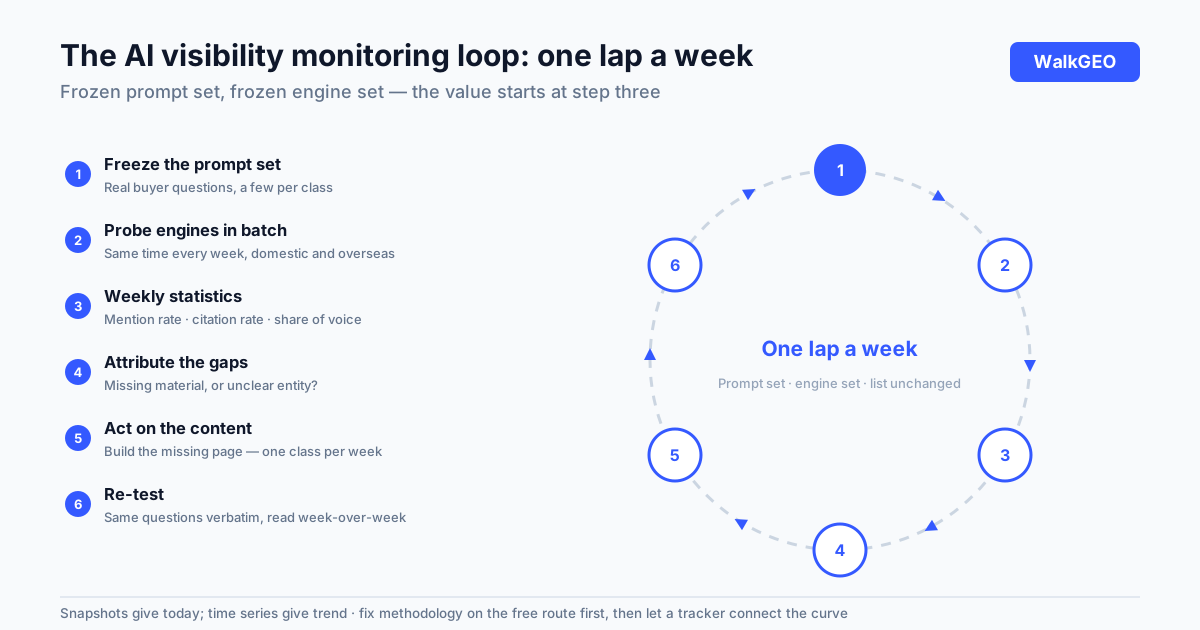
Switching engines mid-stream. Doubao this week, DeepSeek the next, Yuanbao the one after — a month later, no two weeks are comparable and the trend is unreadable. A tracker's value lives entirely in the time series, and the time series holds only when prompt set, engine set, and competitor list stay frozen — the core discipline from measuring brand AI visibility.
The ten, in one table
| # | Tool | Engine coverage | Data exits | Price shape |
|---|---|---|---|---|
| 1 | Profound | ChatGPT, Perplexity, Claude, Gemini, Copilot, DeepSeek, AI Overviews | Reports, 200+ integrations per its site | Enterprise, custom |
| 2 | Peec AI | ChatGPT, Perplexity, Gemini, AI Mode | CSV, Looker Studio, API, MCP | Subscription, trial |
| 3 | Otterly.AI | ChatGPT, Perplexity, AI Overviews, AI Mode, Gemini, Copilot, Claude | Reports | From $29/mo, free trial |
| 4 | Scrunch | Overseas mainline, agent-traffic focus | Citation and agent-traffic reports | Enterprise and agency |
| 5 | AthenaHQ | Base five platforms; paid 11+ incl. DeepSeek, Grok | Reports; API on paid | Free tier + from $295/mo |
| 6 | Ahrefs Brand Radar | AI Overviews, AI Mode, ChatGPT, Perplexity, Gemini, Copilot + Claude | Inside Ahrefs reporting | Add-on from $50 or $199/mo |
| 7 | Semrush AI Visibility Toolkit | ChatGPT, Google AI et al. (per Semrush) | Inside Semrush reporting | Suite module |
| 8 | WalkGEO | DeepSeek, Doubao, Qwen, Yuanbao, ChatGPT, Perplexity | Downloadable reports | Pro ¥99/mo, Business ¥299/mo |
| 9 | HubSpot AI Search Grader | GPT, Perplexity, Gemini (cross-checked) | One-time scored report | Free; continuous $50/mo |
| 10 | LLM Sentry | DeepSeek, Doubao, Bocha | Your own database | Open-source, self-maintained |
The order follows market and form, not rank. Three sections unpack it: the five overseas-first platforms, the suite modules plus free grader, and the China-engine and open-source entries.
The five overseas-first platforms
These five build for overseas engines — the fit is international business and teams selling into Western markets.
Profound: the widest coverage at enterprise budgets
Its published engine list is the widest line in this table: ChatGPT, Perplexity, Claude, Gemini, Microsoft Copilot, DeepSeek, and Google AI Overviews. The product has grown past monitoring into an "AI Marketer" — prompt-volume-led suggestions for content and pages, drafted for approval. SOC 2 is in place, and the site claims a third of the Fortune 100. Verification: ask for a methodology document that states each run's prompt composition; and for the DeepSeek path specifically, request sample results rather than trusting the list on the site.
Peec AI: the smoothest data exit of the ten
A German team in the mid-market, claiming 4,000+ brands and agencies. The monitoring kit is complete: tagged prompt tracking, visibility-sentiment-position metrics, competitor benchmarking, source analysis. What separates it is the data exit — CSV export, Looker Studio connector, API, and MCP all present, so your probing data never lives only inside their dashboard. Verification: export the full dataset by hand once in the trial and confirm the fields are complete.
Otterly.AI: the first tracker at a starter price
Seven platforms listed, from $29/month (November 2026), with a free trial — the lowest paid gate on this list. The product leans light: prompt research, AI search analytics, brand profiles, content audits. The natural first paid step once a manual audit is running. Verification: run your own prompt set in the trial and line it up against your manual records for error size.
Scrunch: the enterprise pick that watches agent traffic
Scrunch positions itself as an "Agent Experience Platform" — beyond counting mentions, it tracks how much traffic AI agents actually send your site and where the citations land, with SOC 2 Type II. Dual lines for enterprise and agencies, with customer cases on its site. If "AI referral traffic" is on your scorecard, this lane deserves a separate look. Verification: pricing isn't public, so ask about cancellation and data migration in the demo — vague terms go straight into your evaluation sheet.
AthenaHQ: start on a free tier, widen on paid
Base tier covers ChatGPT, Perplexity, Gemini, AI Overviews, and Copilot; paid tiers widen to 11+ models — Google AI Mode, Claude, Grok, DeepSeek, Meta AI, and Mistral included (vendor site, November 2026). Pricing: a free tier (Essential, with credit) plus Starter from $295/month. Verification: check whether the free credits carry one full run of your prompt set; if yes, prove the workflow there before discussing an upgrade.
Suite modules and the free grader
Three entries here aren't standalone trackers: two grew inside SEO suites, one is a free one-shot check. Each fits a different moment.
Ahrefs Brand Radar: a paid add-on in two shapes — Custom Prompts from $50/month and the AI Visibility Index (531M+ real prompts) from $199/month; every paid Ahrefs plan also carries a small daily free quota, five prompts on Lite. Data lands inside Ahrefs reporting, which makes it the low-friction option for teams already working there.
Semrush AI Visibility Toolkit: a module inside the suite; per Semrush's own pages, it tracks brand mentions across ChatGPT, Google AI, and other AI platforms and analyzes competitors, sharing an account with your keyword and content tools. For teams folding an AI panel into an existing SEO weekly report. Both suite modules live on overseas engines; domestic engines are usually outside their coverage — check the official engine list line by line before buying.
HubSpot AI Search Grader: free, one-shot — a brand name in, a composite score out within minutes across five dimensions (sentiment, presence quality, brand recognition, share of voice, market competition, out of 100), cross-checked across GPT, Perplexity, and Gemini. It's a snapshot, not monitoring. The right use of a snapshot is as a baseline — then connect the curve with paid monitoring (HubSpot's own at $50/month, or any tracker below).
China's engines and the open-source route
The list closes with two entries: one for teams that need China's engines inside the same monitoring, one for teams who'd rather run the scripts themselves.
WalkGEO: China's engines in the same monitoring loop
Interest declared first: this is our product, so verify every claim below through the public entries rather than trusting our copy. Engine coverage runs six — DeepSeek, Doubao, Qwen, Tencent Yuanbao, ChatGPT, Perplexity — so domestic and overseas business sit in one tool instead of two. Prompt sets are custom, probing runs weekly in batch; Overview shows week-over-week mention, citation, and share trends; gaps become Issues tagged by type and priority, connected to Optimize and the content workflow. Reports download, pricing is public: Pro at ¥99/month, Business at ¥299/month (November 2026), monthly cancelable. Verification: the engine list on the pricing page and the weekly routine in the help center.
LLM Sentry: the scripts are yours
An open-source project on GitHub (daijinma/geo_marketing): Playwright-driven automation that queries DeepSeek, Doubao, and Bocha, records mentions, traces cited sources, and computes share of voice. The fit is teams with engineering hands who want domestic-engine data flowing before any purchase. Two preconditions to think through: when an engine's page changes, your scripts change with it; and the repository carries no license file yet — contact the author before commercial reuse. Cadence and re-test discipline are also yours to enforce. Open source ships the tool; it doesn't ship the discipline.
Can a free grader replace monitoring?
For diagnosis, yes; for tracking, no. A free grader — the one-shot score or a manual audit — answers "what's today's state." Monitoring answers "what changed from last week, and which change did it." Snapshots have no time axis, and every judgment GEO depends on — trend, attribution, whether anything works — lives on the time axis.
The handoff is concrete: run the free routes for two weeks to fix the prompt set, engine set, and competitor list; then take those three into tracker trials and check the tool's detected mentions against your manual records; only after they reconcile, talk pricing. The trial script is unpacked step by step in how to choose a GEO tool, and the full GEO tool landscape fills in the categories beyond monitoring — services, content optimization, self-serve.
From one spreadsheet to a product: how our own monitoring grew
Entry 8 on this list is ours, and it didn't start as a product. The decision points are scattered through the sections above; here they are in one place.
It began as a spreadsheet. WalkGEO's first round of monitoring was manual: a frozen set of questions, four domestic engines first (DeepSeek, Doubao, Qwen, Tencent Yuanbao), overseas engines added in a second batch; same time every week, logging raw answers, brands named, and cited sources. The first probe barely qualified as a baseline — the site was still in Google's "Discovered, not indexed" state, with AI citations even further out. But those numbers became the baseline every later change was measured against.
The spreadsheet didn't last long. Once the prompt set grew, one sheet stopped scaling: week-over-week comparison meant flipping records by hand, and gaps couldn't be attributed item by item. That's when the spreadsheet became a product, carrying over three things the spreadsheet had validated: user-defined prompt sets (methodology follows the set — no unified question bank across customers), weekly batch probing (not hourly — that only amplifies noise), and gaps filed as individual Issues (data must connect to action, or a report stays just a report). Those three decisions still run in the product today, and they're the first three things we look for when evaluating any tracker on this list.
One unfinished piece belongs here too: bulk export of raw probing records currently stops at the report level — finer-grained export is in progress. Evaluate us on that as it stands.
FAQ
What does an AI visibility tracker actually measure?
Four things sit at the core: on a frozen prompt set, per weekly run — your mention rate, citation rate, and share of voice in AI answers, plus gap attribution when you're not mentioned. Competitor benchmarking, sentiment, source analysis, and AI referral traffic are extensions built around that core. Judge a tracker by whether the core is complete and the methodology is explainable, then by the extras.
How does a free grader differ from paid monitoring?
Snapshot versus time series. A free grader (one-shot scoring, manual probing) tells you today's state; paid monitoring connects each week's state into a comparable curve — which is what trend judgment and change attribution need. Use the free routes first to learn what you should measure, then adopt a tool. Reverse the order and you've bought a dashboard with no one-defined question behind it.
Why do most overseas trackers skip China's engines?
Probing domestic engines (DeepSeek, Doubao, Qwen, Tencent Yuanbao) requires local access conditions and answer-parsing adaptations, and overseas tools build for ChatGPT and Perplexity first. A few list DeepSeek in coverage (Profound's site does) — verify that path's probing quality separately before buying. For China-focused work, match the engine list before comparing features.
How many engines should I track at the start?
For a China-focused business, four entrances cover the four engines: Doubao, DeepSeek, Qwen, and Tencent Yuanbao (ByteDance Seed, DeepSeek, Alibaba Qwen, Tencent Hunyuan). For overseas business, add ChatGPT and Perplexity. The discipline that matters is a frozen list tested weekly — not a different engine each day. Stable lists make week-over-week data comparable, and comparable data is what makes trends and attribution possible.
A tracker's deliverable is a time axis, not an answer. Fix the methodology before picking one, reconcile a trial against manual records after picking, then hold the same prompts and engines for four weeks — that's when the data starts talking. WalkGEO accepts inspection on exactly the terms this article uses, with the product and pricing as the full entry point.
Done reading? Run the same audit on your own site
Sign up, then let the agent scan every page and hand you a prioritized fix list. Your first audit is free.
Run a free site audit