GEO search queries: 30 ready-to-use questions to test your AI visibility
GEO search queries are fixed questions you ask AI engines to test brand visibility. Thirty ready-to-use ones, grouped into four quadrants, each with what it tests and how to read the answer.
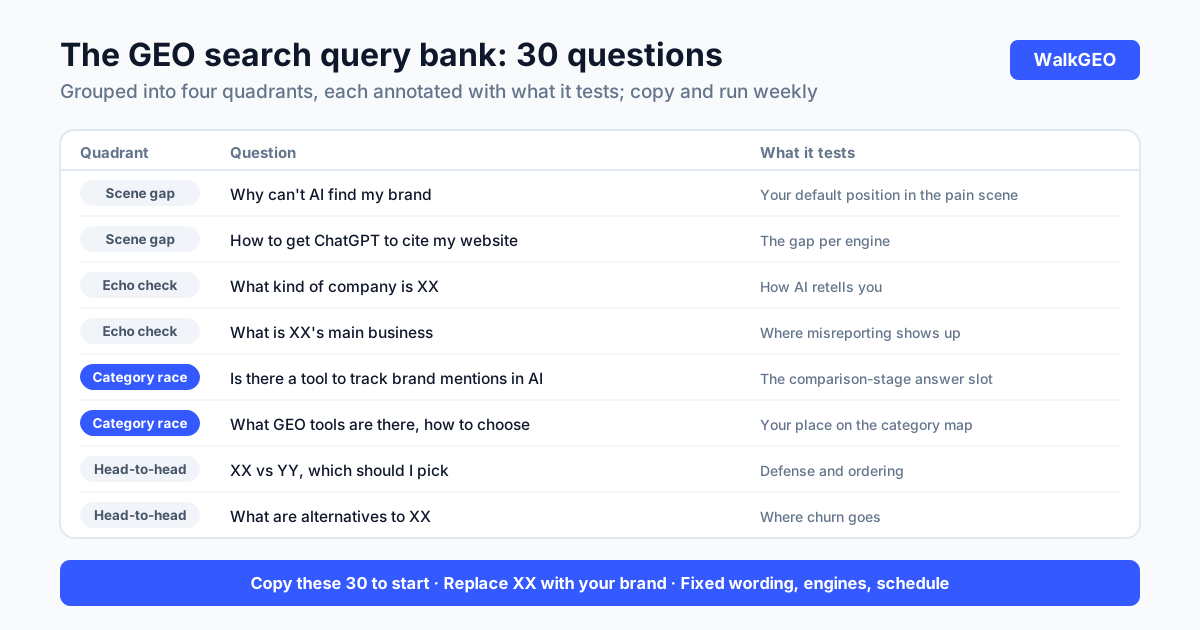
A GEO search query is a fixed question you put to AI engines to measure brand visibility: what you ask, which engine, and how often are decided in advance. There is exactly one way to read it: does the answer mention you, cite you, or hand the slot to a competitor. Below are thirty ready-made questions in four quadrants, each annotated with what it tests, plus the companion log sheet and operating rules; copy them and start.
What people get wrong first
Most people's first question set is copied, not written: generic phrases like "best GEO tools" lifted from competitor blogs, a dozen asked in one sitting, conclusions from memory. All three habits fail. Generic terms cannot detect you: their answer slots belong to big brands, so your only reading is "absent", which never changes. Leading questions return your phrasing as a recommendation. Random timing blends the answer's noise with your own changes.
The fix is one sentence: stop asking on a whim and start asking on a schedule. Fixed wording, fixed engines, fixed time slot, one round per week, answers into a table. With all three unchanged, the four-week comparison holds and answer changes trace to your edits alone. The four groups below are built to that standard.
Check: no "best" or "top" in any line; each line tests one thing.
Group 1: Scene gaps, seven questions
Customers' own words, not your homepage copy. None of these name anyone; they test whether AI brings you up when a customer describes the pain.
| # | Question | What it tests |
|---|---|---|
| 1 | Why can't AI find my brand | The raw phrasing of the gap; your default position |
| 2 | How do I get my company mentioned in AI answers | Who answers this before you do |
| 3 | How to get ChatGPT to cite my website | The gap per engine, plus citation habits |
| 4 | AI search doesn't show my company info, what do I do | Whether info problems route to fix-it content |
| 5 | I've done SEO, do I still need GEO | Who owns the awareness question |
| 6 | Google finds us but AI doesn't, why | The two-engine delta; pinpoints indexing issues |
| 7 | How do we come up when buyers ask AI for suppliers | The B2B decision gap |
How to read: when you appear in this group's answers, content is usually working; when a competitor appears, log the page it cites. Before changing content over an absence, run the pre-publish checklist: if crawlers can't get in, better content won't help.
Check: new chat per question; log the first answer only.
Group 2: Echo checks, seven questions
Named questions test the echo: how AI retells you and whether it is right. XX is your brand; aliases and abbreviations get their own lines.
| # | Question | What it tests |
|---|---|---|
| 8 | What kind of company is XX | The default retelling and positioning |
| 9 | What does XX do, is it reliable | The default trust answer |
| 10 | What is XX's main business | Accuracy; misreporting shows up here |
| 11 | Which is XX's official website | Site identification; indexing and authority signals |
| 12 | Is XX legit, has anyone used it | How much off-site echo (communities, reviews) weighs |
| 13 | Who founded XX | Entity consistency; people facts right or wrong |
| 14 | Is XX worth partnering with | The pre-decision overall impression |
Errors cluster on 10 and 13: business scope, founding details, founder names. Anything that disagrees with your official records goes on the correction list verbatim. If your name has a common misspelling, add one line for it; it tests whether the engine confuses you with somebody else.
Check: verify the name character by character; log wrong claims as quoted, not paraphrased.
Group 3: Category competition, eight questions
What buyers ask when they actually compare. Not one name in this group; whoever holds these answer slots holds the market's shape.
| # | Question | What it tests |
|---|---|---|
| 15 | What GEO tools are there and how do I choose | The category map; are you listed |
| 16 | Is there a tool to track brand mentions in AI answers | Selection by scenario, in the buyer's words |
| 17 | How is AI visibility measured | The tool slot behind the concept |
| 18 | Which XX vendors are good | The category recommendation slot; XX is your category |
| 19 | What tools can check AI citations | The feature-keyword entrance |
| 20 | How much does GEO optimization cost | The service slot behind commercial intent |
| 21 | How do I optimize for AI search | The tutorial slot; content teams' main battlefield |
| 22 | How do I choose a GEO agency for my business | The vendor shortlist |
Two things to read: whether you made the list and which page gets cited; the cited page starts competitive analysis. No comparison page yet? Build first, rank second.
Check: record the top five answers every round, including rounds without you.
Group 4: Head-to-head, eight questions
Named comparisons are the defensive line. Competitor names go in; your position, order, and cited reasons can shift weekly.
| # | Question | What it tests |
|---|---|---|
| 23 | XX vs YY, which should I pick | The head-on recommendation slot |
| 24 | XX vs YY for a small team | Who wins the segmented scenario |
| 25 | XX versus free alternatives, what's the difference | The defense of your pricing logic |
| 26 | Is XX worth buying | The hesitation before conversion |
| 27 | What are alternatives to XX | Where churn goes |
| 28 | How much does XX cost | Price perception; a hot spot for misreported pricing |
| 29 | What are XX's weaknesses | The real wording of the negative slot |
| 30 | XX vs YY, which data is more accurate | The capability comparison |
XX is you, YY is a competitor. Enterprises with several competitors keep one line each; no new lines inside a frozen window. Order changes are worth more than presence changes: moving from third to first usually means it swapped the page being cited.
Check: log the competitor URLs cited; they are raw material for gap attribution.
How to run the table
Fix three things first: wording (never rephrase), engines (a fixed list per question, written into the sheet header; run Doubao, DeepSeek, Yuanbao, and Kimi for mainland business, ChatGPT and Perplexity for overseas, and change the pairing only when the market changes), time (same window weekly). Log with the five-field sheet in the next section; with a tool, automate it; without one, a spreadsheet carries it. The switch point is any one of three thresholds: past fifty questions a round outgrows an hour; past four engines the columns double; a new market needs its own language version. Until then stay manual; that discipline is what no tool replaces.
Where sentences come from and how to balance them is a separate craft: the prompt set guide covers collecting real customer sentences, quadrant ratios, and the four-week freeze. Use this table as the starter set; run one full window before any re-engineering.
Check: one round weekly; a missed round is made up that week, not stockpiled for month-end.
The companion log sheet, five fields
The query bank decides what to ask; the log sheet decides how to record. Five fields, one row per question:
| Field | What goes in | Example |
|---|---|---|
| Date | The round's date, to the day | Nov 9 |
| Question # | Matching the bank, 1–30 | 16 |
| Engine | Which engine this question ran on | Doubao |
| Mentioned | Yes / No / Misreported | No |
| First cited URL | The first link the answer hung | Competitor's pricing page |
One round is thirty rows of weekly record. Columns 2 and 4 cross into your mention rate, column 5 accumulates the citation source list, and any "Misreported" row points at one entity fact to fix. The common shortcut is logging "Mentioned" without the URL, leaving nothing to attribute with later; skip none of the five. Manual-stage gear is one page: bank plus sheet. Where the sheet lives does not matter; archive one copy weekly and export before touching fields. The first round builds a baseline, not answers: most questions will not have you yet, a normal starting point; mark that round as the baseline all later weeks compare against.
Check: five fields, no more; run a full window before adding any.
How to extend the set
Two kinds of legitimate extension beyond the thirty. Scene swap: replace "small team" in group four with your real customer segments; cross-border sellers, chain stores each count as a new question with a different answer slot. Engine focus: swap the generic "AI" for a specific engine name; "how to get Doubao to cite my website" is question 3's mainland variant, and single-engine phrasing tests your position inside that engine. Both obey the same rule: add, never swap; new questions go into the candidate list and start their own window. Misspellings are not a legitimate extension: they test confusion, not position.
Check: extension questions start a new window; never compare their absolutes against old ones.
Where to read the numbers
Three numbers, each with its own article: mention rate in how to measure AI visibility, citations in citation tracking, competitor slots in gap attribution. The discipline here: read weekly, never single-shot; read by quadrant, each cell on its own; four consecutive weeks before any conclusion. Also watch absence streaks: two straight weeks without you in the same quadrant deserves a gap check; a single absent week is noise, hands off. The numbers carry no good or bad, only direction: one more mention than last week is progress.
Where this table came from: in the Search Console top-queries report on November 9, "geo search query" ranked first with 86 impressions and 0 clicks, and "how to get cited by chatgpt" carried 32 impressions in the same report. We appeared in that query's results with no ready-made question bank to catch it; this page is the catch. Your own query report may hide sentences like these: however small the impression count, each line is a full question somebody typed.
Check: scan the query report weekly; copy new phrasings into the candidate list.
Frequently asked questions
Can I copy these 30 questions as-is?
Yes. Replace XX with your brand, competitors, and category, keeping one line per common alias. Freeze the set for four weeks before any change: a single changed word breaks the curve at that point, and four weeks of readings no longer connect. Add questions when events justify them; never swap old ones out.
How many questions are enough?
Enough is not a total count, it is coverage: all four quadrants filled and one full round finishing within an hour. Thirty is a starting point, not a ceiling; past fifty, manual tracking stops scaling and a tool should take over. Add questions with events: new features, new markets, new competitor types.
Should I ask in English or Chinese?
Follow your customers. Mainland customers: ask Doubao, DeepSeek, Yuanbao, and Kimi in Chinese. Overseas customers: ask ChatGPT and Perplexity in English. Ask the same question in both languages, and the places where answers diverge are your market gaps; log them in a separate column.
The answer doesn't mention me. Now what?
A single answer proves nothing; accumulate weekly observations first. Watch three slots separately: mentions, citations, competitor presence. If even the machine face fails, run the free self-check to confirm crawlers get through; where competitors occupy the slot, use gap attribution to see which page they cite, then build yours.
Back to the definition: a GEO search query is a routine with fixed wording, fixed engines, and a fixed schedule, not a passing idea. Copy group one's seven questions into a sheet today, replace XX, open a fresh chat, and take the first round of readings; the first round will probably look bad, and that is normal, the four-week window is just starting. When the routine is proven and you want weekly rounds automated, WalkGEO runs the same table; pricing is the doorway.
Done reading? Run the same audit on your own site
Sign up, then let the agent scan every page and hand you a prioritized fix list. Your first audit is free.
Run a free site audit