Query Fan-Out: One Question, Many Hidden Searches
One user question may become several sub-searches before an answer is assembled. That is query fan-out. A main page covers the core question and a topic cluster covers the smaller ones.
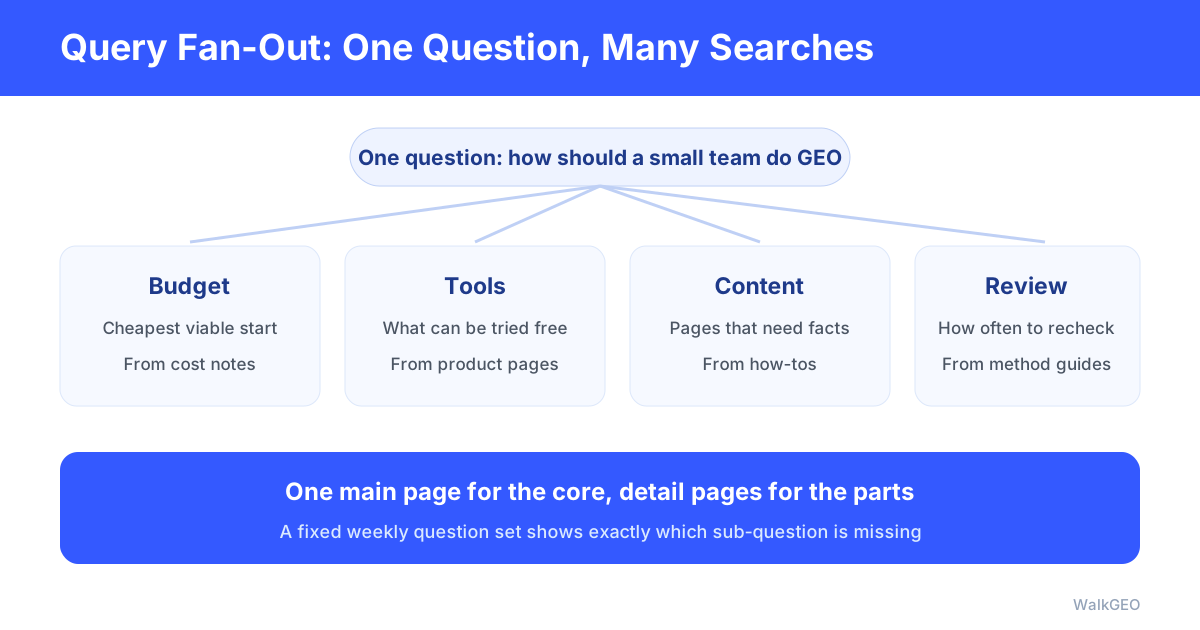
Ask "how should a small team do GEO" and the answer arrives in four parts: a lowest-cost start, a few tools worth trying, pages that must state their facts clearly, and a weekly review rhythm. The user typed one line. The engine looked for four things and merged them. Google calls this query fan-out in its official Search Central documentation: AI Overviews and AI Mode may issue multiple related searches across subtopics and data sources. You do not need to reverse-engineer the mechanics. You need content that holds up when the question is split.
A single question becomes four lines of work
Picture the conversation. One typed sentence turns into four answer blocks, and each block came from a different kind of page. No single comprehensive article supplied all four.
Query fan-out means issuing related searches across subtopics and data sources before an answer is assembled. That is a practical signal. The question in a user's mouth and the task in an engine's view are not the same object. A broad article about the head term can look relevant on all four points while being too vague on each one. The sub-questions have their own best sources, and the engine goes looking for them.
Checkpoint: one main page for the core question, separate pages for sub-questions that can stand alone.
Why does AI split one question into several searches?
Because a seemingly simple question usually contains several smaller ones. Ask how a small team should do GEO and the answer needs budget, tooling, content and a review rhythm. The engine looks for each part and merges them. Google's Search Central documentation calls this query fan-out: AI Overviews and AI Mode may issue multiple related searches across subtopics and data sources. That is a public description, not a guess about internal implementation.
Splitting is reasonable. Complex questions rarely have one source. Budget comes from cost records, tool capability from a product page, content structure from a how-to, review cadence from a method article. Asking one page to do all four well is harder than asking four pages to each do one thing well.
Checkpoint: cite the public description; do not invent engine internals.
Is query fan-out a brand new technique?
No. It names a common way of gathering material in generative search, not a proprietary feature. Classic search also rewrites queries. Generative search moves the step into answer generation: related searches run across subtopics, then the findings are synthesised. You do not need to model each internal step. You need to accept that one user question is often a cluster of questions to the engine.
The word may be new; the work is not. We have always paired a head term with a set of long-tail variants in a keyword sheet. Those variants now do an extra job: they are not just alternative box entries, they are the smaller questions an answer may split into.
Checkpoint: new label, familiar work around a question cluster.
Can one page cover every sub-question?
No, and it does not have to. Give the core question one main page with the definition, the judgement order and routes into the detail. Put each sub-question on the page that owns it, with an answer that stands on its own. The main page carries readers to the detail pages; the detail pages are the ones that can be lifted into an answer. Piling everything into one page looks complete but makes every section compete for the same space.
Three layers make the split concrete:
| Layer | Where it lives | What it carries |
|---|---|---|
| Core | One main page | Definition, order of judgements, links downward |
| Sub-question | The owning topic page | One self-contained answer to one specific question |
| Detail evidence | Specs, FAQ, record tables | Checkable facts, numbers and sources |
The main page is not a table of contents. It must answer its own title question, or the core slot goes to somebody else even if every detail page is excellent. The definition sentence and self-contained paragraph in citeable content are required at both levels.
Checkpoint: the main page gives an answer, detail pages give evidence; do not merge them.
How to derive a sub-question cluster from one question
Take the question you most want to be asked and work through four moves. First, write down what the user would ask next, using their exact words. Second, group those follow-ups into what, how, which and how-to-measure questions; keep differently worded versions separate. Third, find an existing page for each group and record the groups with no page as gaps. Fourth, link from the main page to every detail page so both people and crawlers can follow the path.
The usual mistake is deriving the cluster from your site navigation instead of the user's follow-ups. Your sections may be product, cases and about. The follow-ups are "is there a free plan", "can I try it first" and "how long until I see anything". The two structures do not line up, and pages built from the navigation leave the real question in the wrong section.
Checkpoint: derive from follow-ups, not from your menu.
What we saw in our own query sheet
This is not a thought experiment. In the second batch of real GSC queries, four variants appeared for the same topic: google ai overviews optimization, google ai overview optimization, ai overviews optimization and optimize for google ai overviews. Each had few impressions, but all pointed at one thing. We did not build four pages. We folded all four phrasings into the H2 and FAQ of one article so a single page could catch the whole cluster.
That changed how we think about coverage. Coverage is not a page count. It is how many of the cluster's exact sentences your pages answer explicitly. One page holding four original phrasings beats four thin pages each holding one. If the questions are genuinely different sub-questions rather than rewrites, splitting is right. The deciding factor is the relationship between questions, never a target number of URLs.
Checkpoint: merge paraphrases into one page; split genuinely different sub-questions.
Where this meets prompt-set design
Fan-out describes how an engine gathers material. A prompt set describes how you observe answers on a fixed schedule. They meet here: your set cannot contain only core questions, or you will see whether you were mentioned overall but never which piece was missing.
Add the sub-questions from the previous exercise, in their original wording, to the set and run them weekly alongside the core questions. Prompt set design covers controlling volume and keeping wording stable. How AI picks sources covers the general mechanism behind source selection. Read together, they give you an observation table you can keep. Do not swap questions midstream or the weeks stop being comparable.
Checkpoint: include sub-questions in the set, or you cannot locate the gap.
When a sub-question does not deserve a page
Not every sub-question earns its own URL. If it is a paraphrase of the core question, fold it into the main page or the existing detail page. If there is no checkable answer yet, do not build a page just to fill a slot; thin pages dilute the whole cluster. A separate page earns its place when the question is asked consistently, has a specific answer and that answer is long enough to stand alone.
One more case: hold off when you have never seen the sub-question in an answer. Collect the wording first, the way GEO search queries describes, then decide. Building twenty pages and waiting for queries is the more expensive order.
Checkpoint: stable wording, a concrete answer, enough length. All three, then build.
Common questions
Why does AI split one question into several searches?
Because a seemingly simple question usually contains several smaller ones. Ask how a small team should do GEO and the answer needs budget, tooling, content and a review rhythm. The engine looks for each part and merges them. Google's Search Central documentation calls this query fan-out: AI Overviews and AI Mode may issue multiple related searches across subtopics and data sources. That is a public description, not a guess about internal implementation.
Is query fan-out a brand new technique?
No. It names a common way of gathering material in generative search, not a proprietary feature. Classic search also rewrites queries. Generative search moves the step into answer generation: related searches run across subtopics, then the findings are synthesised. You do not need to model each internal step. You need to accept that one user question is often a cluster of questions to the engine.
Can one page cover every sub-question?
No, and it does not have to. Give the core question one main page with the definition, the judgement order and routes into the detail. Put each sub-question on the page that owns it, with an answer that stands on its own. The main page carries readers to the detail pages; the detail pages are the ones that can be lifted into an answer. Piling everything into one page looks complete but makes every section compete for the same space.
How can I tell whether my content caught the sub-questions?
Run the same question set weekly and record which sub-questions appear in answers and which page supplies each part. If an answer covers five points and your content was cited once, the gap is in the other four. Take that record back to the keyword list and put the user's exact wording into the relevant title and FAQ. Add pages only where a real gap exists.
Back to the opening definition: fan-out means one large question becomes several smaller ones before an answer is assembled. You do not control the split. You control whether each smaller question has a public, checkable answer. When should you look for a tool? Once the question set outgrows a sheet and the same sub-question gaps keep returning, automation starts to pay. Until then, a few tables and a fixed review rhythm are enough. Scope and pricing are on product and pricing. WalkGEO's query sheet groups sub-questions in one record, so the main page and detail pages read the same list.
Done reading? Run the same audit on your own site
Sign up, then let the agent scan every page and hand you a prioritized fix list. Your first audit is free.
Run a free site audit